4 December 2025
News
A shared commitment to safer navigation: MICAD at the Propeller club conference in Naples
On November 4th, MICAD took part in a conference organized by the International Propeller Club of Naples, on the occasion of the 160th anniversary of the Italian Coast Guard, an event that gathered high-ranking military officials, institutional representatives, and key stakeholders from the nautical sector of the Gulf of Naples – one of Italy’s busiest traffic areas – to focus on a single topic: maritime safety.
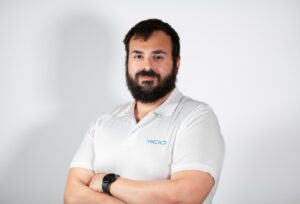
During the conference, Amedeo Migali, Managing Director of MICAD, actively contributed to the debate by offering a design perspective on the challenges that accompany the initial development phases of a pleasure craft: the need to match the client’s aesthetic and functional expectations with the safety requirements imposed by regulations. This is certainly a complex balance, which often highlights the limitations, ambiguities and uncertainties of the current regulatory framework.
Migali analysed, from an engineering perspective, the most recurrent factors in serious accidents, emphasising that very often there is no single isolated error, but rather a causal sequence combining design, maintenance, management and facilities. Furthermore, technical investigations have revealed that navigation errors, maintenance deficiencies, the intrinsic vulnerabilities of small vessels and overconfidence in weather conditions also play a role.
It has been clearly established that although the human factor is often the triggering cause of accidents, it operates within a technical context that can either amplify or mitigate its effects. Modern recreational craft, optimised for both comfort and performance, have narrow safety margins. Just consider the increasingly lighter hulls, extended superstructures, large windows, complex systems and limited accessibility to critical components, all factors that make the management of any unexpected event more fragile than in the past.
In his speech, MICAD’s CEO advocated a change in vision, proposing a fail-safe craft design integrating intelligent risk prevention and mitigation systems. These include environmental sensors connected to automatic functions, electrical redundancy, assisted closing hatches, and robustness criteria borrowed from the aerospace and automotive industries, all of which can drastically reduce the probability of human error.
At the same time, attention was drawn to the gap between the competencies certified by a boating license and the actual capability to manage an emergency. The absence of practical modules dedicated to stability, systems, fire, flooding, and electrical malfunctions highlights the need for advanced training programs aimed at both recreational boaters and professional operators.
Certainly, Migali has not overlooked the potential of AI as an operational support tool: guided checklists, COLREG references, emergency management, load limits, and contextual alerts based on environmental data do all support a more informed use of the vessel.
To solve these problems, there is a need for coordinated effort by all players in the field. For designers, this means systematically integrating risk analysis tools such as FMEA and risk assessment from the early stages of development, refining the ability to predict critical scenarios. Users, on the other hand, are required to know the vehicle in its technical aspects, not just its management.
Furthermore, shipyards are called upon to conduct more rigorous verification of the suitability of retrofits and modifications, to ensure that subsequent interventions do not compromise stability, systems, and the original configuration of the craft. The important role of the authorities should not be underestimated, as they are called to support more targeted controls and disseminate a greater culture of safety.
By combining these efforts, the pleasure boating sector can move toward an ecosystem based on conscious design, adequate checks and greater preparation of operators. A path that MICAD continuously supports.