31 July 2026
Press
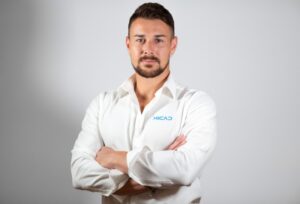
Interview with Andrea Maglie, Naval Engineer and Yacht Designer at MICAD
With a background in nautical engineering in La Spezia and a Master’s degree in Yacht Design, Andrea works at the intersection of structure, systems, materials, and environmental responsibility, approaching each project as a complex organism where every element must function in harmony.
We continue our journey behind the scenes at MICAD. Today we meet Andrea Maglie, who joined the team in 2019 and brings together naval engineering, yacht design, and a strong focus on sustainability throughout the entire lifecycle of a vessel.
With a background in nautical engineering in La Spezia and a Master’s degree in Yacht Design, Andrea works at the intersection of structure, systems, materials, and environmental responsibility, approaching each project as a complex organism where every element must function in harmony.
Q: Andrea, your background combines nautical engineering with a specialization in Yacht Design. How does this dual perspective shape your approach to design?
A: My path has always been a search for balance. My technical education gave me method, precision, and the ability to read a boat through calculations, structures, and real constraints. Yacht Design, on the other hand, gave me a broader direction.
In MICAD, I do not see myself only as an engineer. I am interested in interpreting the boat as a single organism, where structure, systems, spaces, and functions must work together. My role is to find a synthesis between what supports the vessel and what makes it livable, functional, and coherent.
Q: In your work, sustainability is not limited to propulsion, but also involves the materials themselves. What does this mean in practical terms?
A: It means designing while considering the entire lifecycle of the vessel. Not only how it is built, but also how long it will last, how it will be maintained, and what will happen to its materials at the end of its use.
Today, a designer cannot simply draw shapes or solve technical problems. There is a broader responsibility. We need to think like directors of the whole process, bringing together performance, safety, maintenance, and the end of life of the product. It is a shift in perspective: moving from a linear approach to a circular one.
Q: You have explored the use of natural fibers and bio-resins. What value do these materials bring compared to traditional solutions?
A: Their value lies in rethinking the relationship between performance and responsibility. Working with natural fibers, such as flax or cellulose, and with lower-impact resins is not just an aesthetic or symbolic choice. It means looking for solutions that can ensure quality, durability, and greater environmental awareness.
I am very interested in the idea of giving value to materials that come from nature or from recovery processes. It is not about following a trend, but about building a more conscious design approach, one that can last over time and reduce the overall impact of the vessel.
Q: Another key theme in your approach is design for disassembly. How does this change the way a boat is conceived?
A: It changes the entire perspective, because maintenance and end-of-life management become part of the project from the very beginning.
Designing furniture, systems, and components with modular solutions and mechanical fixings makes access, repair, replacement, and future material separation easier. We should not think only about the finished object, but also about what it may become over time.
For me, this is a form of respect: for those who will use the boat, for those who will maintain it, and for the materials themselves. We should not design a future waste, but a system of elements that can continue to have value.
Q: In a complex sector such as yachting, how can material innovation be combined with the safety and performance required by the market?
A: Through validation. Innovation cannot remain an interesting intuition: it has to be tested, measured, and made reliable.
There are very stimulating frontiers, from bio-resins to polymers that can be recovered or chemically transformed. But every new solution must meet precise tests, regulations, and performance requirements.
In MICAD, this aspect is essential. The strength of our work lies in integration: every choice, even the most innovative one, has to interact with the structure, the systems, safety requirements, and the final experience of the owner and the people on board.
Q: What is the final objective you pursue by integrating different areas such as structure, systems, and sustainability?
A: The objective is to close the circle.
I am interested in reaching a way of designing in which the boat is not only efficient and beautiful to live in, but also more intelligent in its relationship with materials. A boat designed to last, to be maintained more easily, and one day to return value through its components.
For me, designing means creating a fluid relationship between what supports the boat and what makes it livable. When this relationship truly works, those on board do not perceive the technical complexity behind it: they simply experience comfort, balance, and naturalness.