4 May 2026
Press
Design thinking as a mindset
In contemporary design, there is still a lingering belief that creativity belongs exclusively to individual talent, a rare gift reserved for a few. But is that really the case?
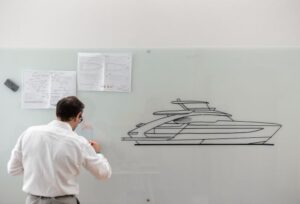
Amedeo Migali, founder of MICAD, offers a different perspective: «Creativity isn’t something you wait for, it’s something you cultivate through discipline and study». He continues: «I clearly remember when this vision took definitive shape. Together with Nicola Palasciano, MICAD’s Chief Design Officer, we decided to join the Design Thinking program at MIT Sloan.»
For Migali, the experience meant a great deal. Rather than a «simple» acquisition of technical tools, this methodology triggered a true transformation in the way design is conceived. Design Thinking ceased to be a linear process and became an iterative mindset, an attitude that now permeates the entire working community.
This approach is built on a structure that is both solid and flexible:
- Empathy and user focus: empathy is treated as a concrete design parameter.
Adopting a user-focused approach means understanding the vessel as an ecosystem of experiences, where every architectural decision is filtered through a fundamental question: «How does this solution improve the life of the person who will inhabit this space?». Here, function does not simply follow form, but is shaped by the real, conscious and unconscious needs of the human being. - Rapid prototyping: through physical models and advanced digital simulations, the team tests ideas as they emerge. This method makes it possible to identify limitations in the early stages, transforming every piece of feedback into valuable data to reach the optimal solution.
- Collaborative participation: the final pillar concerns the very architecture of the organisation. Historically, naval design has suffered from excessive fragmentation, with engineering, design and systems often operating as isolated domains. MICAD, instead, promotes a holistic vision of the project, where collective participation replaces compartmentalisation. Overcoming so-called «departmental silos» means that every member of the MICAD team contributes to a complete understanding of the project. The continuous exchange between the Chief Design Officer and the technical team results in a true fusion of expertise. We are therefore talking about a form of collective intelligence that ensures no part of the project is sacrificed in favour of another: aesthetics does not hinder functionality, and engineering does not compromise beauty. The result is a cohesive, harmonious and technologically refined outcome.
It is therefore clear that, to evaluate the excellence and innovation of a studio, it is not enough to rely solely on the quality of its outputs. One must go further. And, above all, even over time, ask: «How strong is the internal culture of my company?».
In this regard, MICAD places particular emphasis on training. Dedicating time and investing in recurring learning sessions is a strategic lever. It means that the organisation cares about the future of its people and chooses to invest in supporting their ambitions. All of this responds to a precise need: to build a community of professionals who, beyond technical languages, share a common vision of the design challenge. An essential differentiating approach in today’s context. It is precisely for this reason that, in a complex sector such as yachting, adaptability and lateral thinking become fundamental assets that only structured training can guarantee.
So, are we born creative, or do we become so over time? In a complex organisation such as MICAD, maintaining creativity requires discipline. However, it is through the Design Thinking approach that innovation can be governed and made repeatable. Creativity thus becomes a daily discipline, an exercise in listening and synthesis that makes it possible to transform ambitious visions into concrete, functional nautical realities.