17 September 2026
Press, R&D
Designing an experience
Designing a yacht means designing an experience.
Years later, people remember the light entering the saloon at dawn, the silence of a night at anchor, a long dinner on deck or the first step from the stern into the water. These moments may seem spontaneous. The conditions that make them possible take shape from the very beginning of the design process.
We approach a yacht as an environment created to be lived, shared and remembered. Every project begins with a simple question: how should life on board feel?
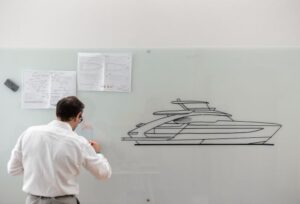
Experience begins at concept stage
The experience on board grows from the earliest decisions made during the project. The arrangement of the spaces shapes the way people move and gather. The relationship between the deck and the sea determines how naturally people connect with the water.
Proportions, openings and sightlines influence the sense of protection, openness and connection with the surroundings. Even the simplest moments depend on a long sequence of choices. A quiet saloon requires acoustic performance and vibration control to be considered from the first stages. Easy access to the sea involves freeboard, structure, safety systems and stern geometry. Comfortable movement on board comes from carefully planned circulation, ergonomics and systems integration.
Designing around the way people live
A yacht responds to different needs throughout the day: it may offer privacy in the morning, support navigation during a passage and become a shared social space in the evening.
The same area can accommodate dining, relaxation, entertainment or a quiet moment overlooking the sea.
Layout design begins with an understanding of how people will interact with every space.
Where will guests naturally gather? How easily can they move between indoor and outdoor areas? Can each space adapt intuitively to different moments? Does every space provide the right balance of openness, comfort and protection? These questions guide decisions that may appear small on paper and have a significant impact on life on board.
The position of a seat can influence conversation. A carefully placed opening can frame the sea from inside the yacht. The design of a bathing platform can turn access to the water into one of the defining features of the vessel.
Engineering what feels effortless
The most successful solutions often feel simple and intuitive. A clean interior, a generous opening or a flexible exterior space results from a precise process of engineering, analysis and coordination.
Hydrostatics, structure, propulsion, weight distribution and systems integration develop alongside the architectural vision. Every discipline influences the others, making close collaboration essential throughout the project. This integrated approach allows technical complexity to remain in the background. The owner experiences comfort, quietness and ease of movement through solutions developed and refined over time. What feels natural on board is often the result of decisions considered in detail months or even years earlier.
What people remember
Specifications define performance, safety, efficiency and feasibility. Their value becomes tangible through the experiences they make possible. A carefully calculated dimension becomes a space where people can gather comfortably around a table. A structural solution creates an uninterrupted view of the horizon. An acoustic study brings quietness to an evening at anchor. A carefully developed stern becomes the place from which a family reaches the sea. Technical decisions acquire a human meaning through the way people experience them.
A yacht may first attract attention through its profile, materials or performance. Its lasting value comes from the life that unfolds on board. For MICAD, designing an experience means imagining that life throughout every stage of the project, from the first calculation to the final detail.